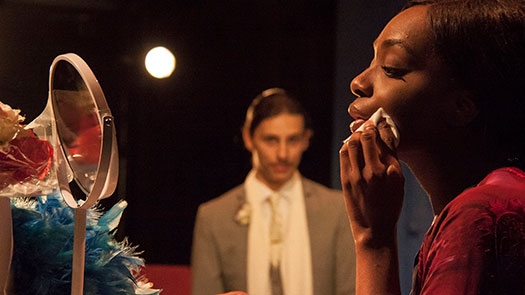
Acting
Acting
BA (Hons) Acting is a vocational training programme with an outstanding reputation for training actors in the skills of theatre, radio, TV and film; more recently encompassing motion capture and animation.
We are looking for your curiosity, imagination, and playfulness. You will be expressive people who are energetic, dynamic and driven to tell stories. We will teach you your craft and encourage you on the path to creative excellence. Through diverse creative modules, you’ll refine your skills and gain the experience needed to excel in a broad range of industry environments.
You’ll be trained by industry experts with specialisms in directing, voice and movement, acting, and theatre-making - academic professionals who continue to work in the field and many of whom are engaged in theatre and performance research.
Studying within our state-of-the-art theatre facilities in the heart of Manchester, a vibrant cultural hub, you'll have access to a wealth of theatres, festivals, and performance events, all of which will enrich your learning.
Special Features
- —Federation Membership: As a proud member of the Federation of Drama Schools, our three-year programme equips you with the skills to excel across diverse performance mediums and adapt to industry demands.
- —Bursaries and Scholarships: You’ll have the chance to apply for prestigious awards like the Carleton Hobbs, Spotlight Prize, and the Buffini Chao Elevate Scholarship.
- —Industry Connections: Rooted in tradition but future-focused, we maintain strong connections with key employers like the BBC, ITV, and The Royal Exchange Theatre.
- —Professional Training: Our industry-experienced team offers hands-on training in areas such as motion capture, acting through song, devising, and puppetry.
- —Collaborative Opportunities: As part of Manchester Metropolitan University, you can collaborate with departments like Digital Arts, Law, and the Manchester Writing School.
- —Expert Lecturers: You’ll learn from professional lecturers and visiting experts who ensure you receive cutting-edge, relevant training.
- —State-of-the-Art Facilities: With purpose-built rehearsal rooms and a dedicated theatre, you’ll train and perform in a professional environment.
- —Cultural Hub: Located in Manchester’s cultural heart, you’ll have access to theatres, festivals, and performance events to enrich your experience.
Watch the BA (Hons) Acting showreel. More videos of our students performing can be seen on the Acting Showcase page.
Course Content
The first two years of this course are all about training. The third year is industry facing, preparing and readying our actors for the profession. The first year is entirely process driven with little emphasis on performing. The second year introduces elements of performance through workshops and culminates in a black box production readying the students for the third year.
Year 1
In the first year of your training you will explore your voice, your body and your self. You will experience the ensemble as a tangible, meaningful presence and you will begin the rudiments of the actor’s craft, working with key principles derived in part from the work of Konstantin Stanislavsky, Uta Hagen and Michael Chekhov. You will learn how to read a play and turn dried ink into character and action. You will learn the rudiments of working on camera and have several opportunities to experience truthful self and the transformation into a present character. You will start to apply what you have learned in a series of scene studies working with both contemporary and European Naturalism texts. By the end of your first year you will have experienced using self as the basis of character and have established a personal, structured process to apply to rehearsal.
Developing Voice and Movement
You’ll begin developing your actor training through dedicated Voice and Movement classes.
Voice: You’ll develop breath, sound, and vocal expression to enhance clarity, resonance, and truthful communication. You will discover new ways of using your voice, helping you speak and perform text effectively and safely.
Movement: This part of the module develops integrated movement actor training through core competencies in movement and embodiment, focusing on presence, intentionality, and awareness of how the body informs character, storytelling, and performance.
Exploring Voice and Movement
You’ll continue your exploration of actor training through distinct and specialised Voice and Movement classes, focusing on how these skills are applied in performance.
Voice: You’ll explore expressive techniques to bring text-based and devised work to life, enhancing clarity, emotional range, and adaptability, while continuing to extend your vocal range, power, presence, and flexibility.
Movement: You’ll explore physical storytelling, ensemble interaction, and responsive embodiment, building agility, presence, and expressive range while deepening your understanding of how movement supports character and narrative.
Exploring Acting for Stage and Screen
In this module, you will continue your exploration of performance for stage and screen through a diverse range of texts and source materials, deepening your understanding of character, narrative, and theatrical form.
You will take part in a series of acting projects that develop your ability to inhabit character. Beginning with ancient texts, you will explore key principles of performance before moving into contemporary works set in recognisable worlds. The module culminates in the creation of imaginative, actor-led devised performances, emphasising physical invention, ensemble collaboration, and the transformative use of minimal resources, inspired by the practices of established theatre companies.
Alongside this, acting technique classes will focus on developing truthful, embodied performance. You will experiment with voice, movement, and presence to create dynamic, responsive, and transformative storytelling.
Developing Practice
Through acting projects you will explore the creative demands of the ensemble, developing playfulness, collaboration, responsiveness, and presence through practical development that emphasises embodiment, engaging with Commedia dell’Arte and Performance Histories.
Through acting technique classes, you’ll develop acting principles using Stanislavskian approaches and develop textual analysis and interpretation skills to strengthen your understanding of character, text, and performance choices. You’ll also begin an introduction to acting for screen, applying these principles in front of the lens to develop screen-specific performance skills.
Year 2
In the second year of your training, you will consolidate and develop what you have learned in the first year. You will work have considerably more experience in front of the camera as well as behind the mic. You will work with heightened stakes, intense feeling and poetic speech through your Shakespeare project and you will have further classes in singing, combat, acting for camera, improvisation, poetry, as well as deeper and more sustained scene studies in which to develop your process and hone your craft.
Advanced Voice and Movement
In this module, you’ll advance your technical and expressive skills to meet the demands of complex performance texts and heightened theatrical styles. The focus will be on extending your vocal range and physical vocabulary, integrating body and voice work, and developing confident, imaginative, and responsive performance in both ensemble and solo contexts.
Connecting Practice
In this module you’ll participate in practical workshop sessions, self-directed tasks, and small group rehearsals, with regular opportunities for director and peer feedback. Performing in front of an audience will be an integral part of your learning.
The module begins with an exploration of Shakespeare, where you will connect with classical text to develop your understanding of language, character, and theatrical form. Following this, you will enter a Black Box intensive rehearsal period, concluding with the in-house realisation of a full directed playtext within a stripped-back theatrical aesthetic.
Advanced Acting for Stage and Screen
Through acting projects focused on 20th-century texts and an intensive screen project, this module advances your acting for both stage and screen, deepening your understanding of character psychology, motivation, and emotional truth while further developing your on-camera skills.
Through acting technique classes, you will engage with the challenges of building awareness of impulse, character, and truthful performance. You will engage with advanced techniques to explore imaginative characterisation, physicality, and expressive use of the body.
Furthermore, you will focus on presence, ensemble play, and the inventive use of minimal resources.
Year 3
Your final year is very much about preparing for and engaging with the profession. You will work with professional directors on at least one public performance per term. You will have workshops and talks from practitioners and professionals including successful directors of stage and screen, agents, producers, casting directors, artistic directors and many more. You will have the opportunity to audition for the various awards and bursaries, including the Sam Wannamaker Festival, the Carleton Hobbs Bursary Award (which we have won and come runner up in several times in recent years) the RSC weekend and many more. You will receive advice on auditions and self-tapes culminating in a series of mock auditions. You will also take part in the annual Showcase, which will be at our new theatre in Manchester and in a West End theatre in London.
Independent Project
In this module, you will explore the wider applications of theatre-making. You will be empowered to create your own projects individually or collaboratively, stepping into roles beyond the stage, thus experiencing the life of a multi-disciplinary artist.
Professional Portfolio
This module equips you with the essential knowledge and skills required to navigate the professional landscape. Through a series of engaging workshops and simulated experiences, you will learn about auditions, self-tapes and the business side of being a professional actor. This will give you the opportunity to develop an industry-standard professional portfolio.
Spring Production
In this module, you will enter the “advanced pre-professional mode” as you work within a full-scale theatrical production with an alternate style to that of Autumn Production. Spring Production allows you to experience a different theatrical genre whilst working alongside an internal or external professional director, creative team and technical crew.
Autumn Production
In this module, you will enter a "pre-professional mode" as you work within a full-scale theatrical production. ‘Autumn Production’ serves as a valuable tool, allowing you to experience what it is like to work alongside an internal or external professional director, creative team and technical crew.
Assessment Methods
Continuous assessment and public performances.
Assessment Weightings & Contact Hours
10 credits equates to 100 hours of study, which is a combination of lectures, seminars and practical sessions, and independent study. A three year degree qualification typically comprises 360 credits (120 credits per year). The exact composition of your study time and assessments for the course will vary according to your option choices and style of learning, but it could be—
Study
- Year 1 75% lectures, seminars or similar; 25% independent study
- Year 2 70% lectures, seminars or similar; 30% independent study
- Year 3 65% lectures, seminars or similar; 35% independent study
Assessment
- Year 1 100% coursework
- Year 2 100% coursework
- Year 3 100% coursework
Staff
- Sofia Jones
Programme Leader
— - Gareth Aled
Lecturer (Acting)
— - Seán Aydon
Lecturer (Acting)
— - Jeremie Cyr-Cooke
Lecturer
— - Ellie Hawthorne
Lecturer (Voice)
— - Amaia Mugica
Senior Lecturer (Movement)
— - Sam Robertson
Lecturer (Voice)
— - Caitlin Smith
Senior Lecturer (Movement)
—
Visiting Tutors
Some of our recent visiting teachers and practitioners—
- Naomi Ackie, Actor, Star Wars
- Geraldine Alexander, Actor & Director
- Sarah Amankwah, Actor
- Hammed Animashaun, Actor
- Mina Anwar, Actor & Director
- Zawe Ashton, Actor
- Mark Babych, Artistic Director, Hull Truck Theatre Company
- Mick Barnfather, Teacher & Actor
- Zora Bishop, Actor
- George Bukhari, Actor
- Lucy Campbell, Director
- Ian Chesworth, Singing Teacher
- Jude Christian, Associate Director, HOME
- Caroline Clegg, Director
- Kate Colgrave Pope, Teacher & Director
- Michael Cox, Hammond Cox Casting
- Kwesi Davies, Coaching For Creators
- Matthew Dunster, Director
- Joe England, Improvisation
- Stefan Escreet, Director
- Comfort Fabien, Actor
- Ashley Gerlach, Actor
- Rupert Goold, Artistic Director, Almeida Theatre
- Darren R Gordon, Director / Acting and Presentation Coach
- Burn Gorman, Actor
- Thom Hammond, Hammond Cox Casting
- Seb Harcombe, Director
- Sir David Hare, Writer
- Julie Hesmondhalgh, Actor
- Elianne Hawley, Actor & TV teacher
- Graeme Hawley, Actor & TV teacher
- Carla Henry, Actor
- Sharon Henry, Sharon Henry Management
- Kaitlin Howard, Stage Combat tutor
- Chris Hunter, Actor & Teacher
- Jonathan Kent, Director
- Oliver Kent, TV Producer
- Noreen Kershaw, Actor & Director
- Elliot Knight, Actor
- Alastair Knights, Director
- Jerry Knight-Smith, Casting Director, Manchester Royal Exchange
- Neil LaBute, Writer
- Omar Malik, Actor
- Cheryl Martin, Writer & Director
- Jonathan Martin, Director
- Javier Marzan, Improvisation
- Jonathan McGrath, Director & Actor & Producer
- Roger Michell, Director, Notting Hill
- Rachel O’Riordan, Artistic Director, Lyric Hammersmith
- Mary Papadima, Director
- Craig Parkinson, Actor
- Maxine Peake, Actor
- Madeleine Potter, Actor & Director
- Quarantine, Theatre Company
- Joe Gilmour Rees, Director
- Kyle Rowe, JAM
- Indhu Rubasingham, Artistic Director, Kiln Theatre
- Ginny Schiller, Casting Director
- Bryony Shanahan, Joint Artistic Director, Manchester Royal Exchange
- Elizabeth Shofi, Voice
- Penelope Skinner, Playwright
- Teunkie van der Slujs, Director
- Simon Stephens, Playwright
- Hannah Stevenson
- Abii Strudwicke, Voice
- Imogen Stubbs, Actor, Director & Writer
- David Threlfall, Actor
- Si Trinder, Actor & Director
- Pat Trueman, Director
- Ted Van Griethuysen, Actor
- Annie Wallace, Actor
- Yusra Warsama, Actor & Director
- Roy Alexander Weise, Joint Artistic Director, Manchester Royal Exchange
- Jason Wingard, Director
Also see Directors of Final Year Productions
Graduates
Former students who have gone on to highly successful careers in film, television and theatre and graduates include Sarah Amankwah, Zawe Ashton, Zora Bishop, John Bradley, George Bukhari, Amanda Burton Steve Coogan, Ashley Gerlach, Richard Griffiths, Graeme Hawley, Zoe Henry, Bernard Hill, Noreen Kershaw, Elliot Knight, Adam Kotz, Nathan McMullen, Yasmin Mwanza, David Threlfall, John Thomson, Annie Wallace, Julie Walters CBE, Assad Zaman.
Making an Application
How to Apply
Apply through UCAS.
We will invite you for an Audition.
You will be notified of our decision through UCAS.
Entry Requirements
| UCAS Tariff Points/Grades Required | 104-112. GCE A levels - grades BCC or equivalent Pearson BTEC National Extended Diploma - grade DMM Access to HE Diploma - Pass overall with a minimum 106 UCAS Tariff points UAL Level 3 Extended Diploma - grade of Merit overall OCR Cambridge Technical Extended Diploma - grade DMM T level - We welcome applications from students undertaking T level qualifications. Eligible applicants will be asked to achieve a minimum overall grade of Merit as a condition of offer IB Diploma - Pass overall with a minimum overall score of 26 or minimum 104-112 UCAS Tariff points from three Higher Level subjects Other Level 3 qualifications equivalent to GCE A level are also considered. A maximum of three A level-equivalent qualifications will be accepted towards meeting the UCAS tariff requirement. AS levels, or qualifications equivalent to AS level, are not accepted. The Extended Project qualification (EPQ) may be accepted towards entry, in conjunction with two A-level equivalent qualifications. Please contact the University directly if you are unsure whether you meet the minimum entry requirements for the course |
|---|---|
| Specific GCSE Requirements | GCSE grade C/4 in English Language or equivalent, e.g. Pass in Level 2 Functional Skills English |
| Additional Requirements | Please note the University does not accept deferred applications or advanced entry applications for this course Audition required. The course is highly competitive and you may be called back to a second or even third audition. Further details |
| International Baccalaureate | IB Diploma with minimum 26 points overall or 104 UCAS Tariff points from Higher Level. If you plan to meet the Level 2 course requirements through your IB Diploma you will need to achieve Higher Level 4 or Standard Level 5 in English Points |
International Students
A minimum IELTS score of 6.0 overall with no individual element below 5.5 is required.
There’s further information for international students on our international website if you’re applying with non-UK qualifications.
Tuition Fees 2026 Entry
UK and Channel Island students
Full-time fee: £9,790 for the 2026/27 academic year*. £10,050 for the 2027/28 academic year*. Fees for subsequent academic years may increase for inflation to reflect increased costs of course delivery (up to a maximum of 10% per academic year) and/or changes in UK government regulation. Inflationary increases will be calculated by reference to RPIx (RPIx is a measure of inflation in the UK). Fee increases are subject to limits imposed by UK government regulation.
Find out about the extra support we may be able to provide with our scholarships for UK students.
EU and non-EU international students
Full-time fee: £21,500 per year. Tuition fees will remain the same for each year of your course, providing you complete it in the normal timeframe (eg no repeat years or breaks in study).
Many of our international students are eligible for a discount on their tuition fees. Visit our scholarships and funding pages to find out what's available for you.
Additional information
A degree typically comprises 360 credits, a DipHE 240 credits, a CertHE 120 credits, and an integrated masters 480 credits. For courses that offer a placement year option the tuition fee for the placement year in 2027/28 is £2,010*. For courses that offer a study year abroad option the tuition fee for the study year abroad in 2027/28 is £1,505*. Placement year fees and study abroad fees for subsequent academic years may increase for inflation to reflect increased costs of course delivery (up to a maximum of 10% each academic year) and/or changes in UK government regulation. Inflationary increases will be calculated by reference to RPIx (RPIx is a measure of inflation in the UK). Fee increases are subject to limits imposed by UK government regulation.
* Subject to Parliamentary approval.
See Funding your studies for further information and advice.
Additional Costs
Specialist Costs
Headshots
Year 2 professional 'headshot' photography approximately £150 - £400 (mandatory).
Specialist equipment
Knee pads for movement - prices start from £10 (optional).
Professional Costs
Spotlight membership - Final year - £75 initial joining fee, rising to £154 per year (mandatory).
Equity membership – Years 1/2/3 initial joining fee £49.50 per year rising with annual income (optional).
Other Costs
Field trip
Final year mandatory trip - Return ticket to London for Showcase between £70-£100 (based on rail ticket) subject to change. Other modes of transport can be used, and prices start from £7.50 (based on coach ticket) subject to change.
Laptop
We would encourage students to have or buy a laptop at onset of the course, to facilitate the best possible learning environment. The approximate cost of this could be between £500 - £1000.
Should a student be unable to purchase a laptop, or use an existing one, we have on-site PC labs and the option to borrow laptops from the library.
* All amounts shown are estimates.